// Travel log · Sindhupalchok, Nepal
Panch Pokhari
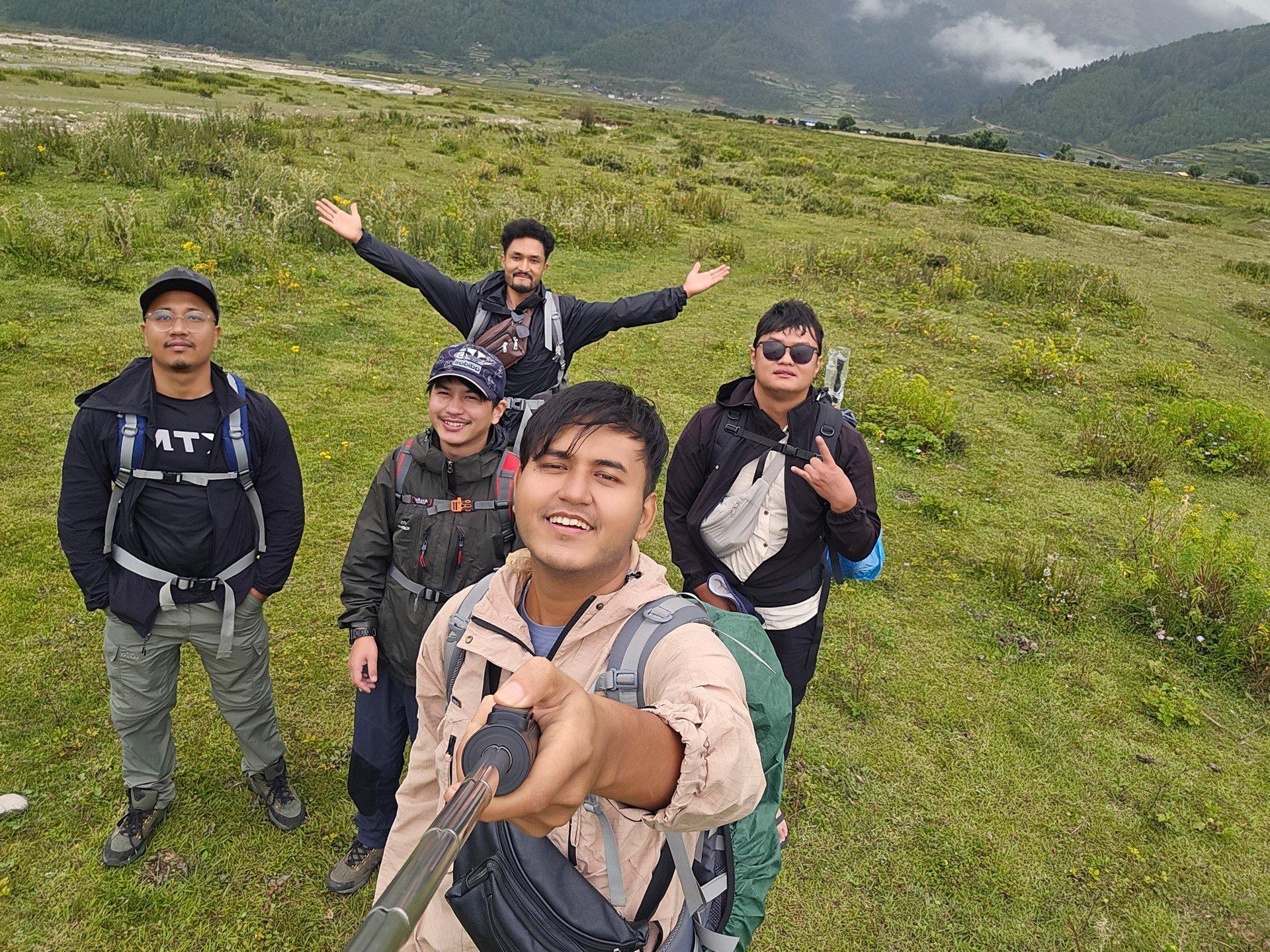
Four of us, three motorbikes, and a road the landslide had eaten before we'd walked a single step. Ten hours of stone stairs into fog, one freezing dip borrowed from the pilgrims — and forty minutes when all five lakes came out. My first trek, told the way I remember it.
Day 01
Three bikes, one missing road
BhaktapurMelamchiBhotangChhimtiTuppi Danda
The hill had eaten the road. That's not a figure of speech. We came around a bend past Bhotang and the road simply wasn't there anymore — a slope of raw, wet earth where the monsoon had dragged everything down toward the river, and our three bikes idling in a row in front of it.
Watching your friend ride a strip of mud does something to your stomach that no viewpoint ever will.
For a while nobody said anything. The engines ticked. Somewhere below, the Indrawati kept making the sound it had made all morning, like static turned all the way up.
The detour was obvious and terrible: a farm track climbing up and around the slide, churned into chocolate-colored soup, older tire marks half-melted into it. Four of us, three bikes — one had been riding pillion all morning, and this is where that arrangement earned its keep. He got down and walked the broken stretch on foot while the rest of us took the mud one bike at a time, on the theory that a lighter bike is a friendlier bike. I remember watching the first of us go — first gear, both feet down, engine whining — and I remember that watching your friend ride a strip of mud with a drop on one side does something to your stomach that no viewpoint ever will. Then it was my turn, and the world shrank to the two meters in front of my wheel.
The detour cost us an extra hour and a half. Nobody went down. When we finally rolled back onto actual road and picked our walker back up, my hands ached from gripping, and all four of us were laughing about nothing in particular.
We had left Bhaktapur before six that morning — there's a photo from the start, one of us masked and half asleep, the streets behind still empty and blue. The plan: pick up the fourth of us at Banepa, climb over the Sanga hill past Kailashnath Mahadev — the enormous Shiva statue that watches the highway — and drop into the Melamchi valley. An easy half day, we thought. But it was mid-August, deep monsoon. Every cliff had grown a waterfall. The rice terraces were an unreasonable shade of green. We kept stopping — for photos, for tea, for a plate of dal bhat at eight in the morning at a roadside place, because someone smelled it, and that was that.
Melamchi itself made us go quiet for a stretch. The 2021 flood tore through here and redrew the whole riverfront; three years on, you could still read the height of the water on the buildings, and the road up the valley still hadn't decided what it wanted to be — asphalt, then gravel, then hope. This is Sindhupalchok, a district that has spent a decade rebuilding: the 2015 earthquake, then this. You ride through it, and your little adventure starts to feel very optional.
Chhimti, around 1,800 meters, is where the engines stopped for good — the last teahouses at the end of the drivable world. We ate again (dal bhat; you'll notice a theme), tied the helmets to the bikes, and traded them for backpacks. And then, for the first time all day: quiet. Just boots on the trail and water running somewhere below. After nine hours of engines, the silence was so complete I kept checking over my shoulder.
Two hours of easy uphill through the corn fields, and Tuppi Danda appeared above us — blue tin roofs on a hilltop at 2,320 meters, cloud wandering through the yard at head height. Dinner was dal bhat with buff sukuti, and local raksi in small steel cups that kept getting quietly refilled. Rain started on the tin roof. We talked rubbish until we were too cold to keep sitting, then went to bed and listened to it.
First day of my first trek ever, and we'd barely walked. I fell asleep thinking tomorrow couldn't be that hard.
As it happened
06:19 masked up, half awake, all in
07:16 threading out through Bhaktapur's streets
08:14 dal bhat no. 1, roadside
11:20 waterfall stop no. 3, approximately
11:48 the road is missing
14:11 a stream over the road; ridden, not waded
~16:00 Chhimti — engines off for good
17:29 walking, finally
19:00 sukuti and raksi, Tuppi Danda
Day 02
Up the staircase, into the weather
Tuppi DandaTapkharkaNasim PatiPanch Pokhari
Tomorrow was that hard.
You stop looking up, because looking up is bad news.
The number nobody had said out loud at dinner: close to eighteen hundred vertical meters in a day. Almost all of it stairs — actual stone stairs, laid by hand up the entire flank of the mountain, by people who apparently never needed to rest. In monsoon, water uses them too. It comes down while you go up.
We left at seven, after a group photo on the teahouse steps, everyone doing confident faces. Mine lasted roughly until the first long flight.
An hour in, a suspension bridge — the long, high kind, strung with prayer flags gone pale from the weather. Something you learn quickly: four people can't cross a bridge like that in step. It picks up a rhythm of its own, and then it has you. Halfway across I stopped, held the cables, felt the whole thing breathe under my boots, and decided the river below was best appreciated from the far bank.
The trail broke the climb into installments with names: Tangu Kharka, Rato Mato, Chokar Danda, Tapkharka. On a map, waypoints. On the ground, each one was a roof, a kettle, and an excuse to stop climbing for ten minutes. The forest in between did not do views that morning — it did dripping. Oak and rhododendron, moss on everything, cloud sitting right in the branches. Then, around a quarter to ten, a hole opened in the weather and we saw what we'd climbed above: the entire valley filled with cloud, flat and white, ridgelines standing out of it like shorelines. Ten minutes, maybe. Then it sealed shut, and we went back to climbing inside the grey.
A little later, we heard drums.
Around a bend there was a pool beside the trail, a blue tarp strung over it, and figures standing waist-deep in the water in ceremonial dress, drumming. Jhankris — shamans — bound for the lakes for Janai Purnima, holding rites at the sacred waters on the way up. We stood at the edge in our rain jackets, dripping and out of place, and watched for a while. Nobody asked us to leave; nobody waved us closer. We walked the next stretch without much talking.
The middle of the day comes back in pieces. A white goat lying across the stairs, chewing, with no plans of moving, so we went around it. Two village kids who looked at us, looked at each other, and burst out laughing — no explanation offered; honestly, none needed. Lunch somewhere above three thousand meters, inside a cloud: dal bhat again, a loaf of sweet bread torn four ways, a bottle of something fizzy passed around, warm as tea.
Then the afternoon, which I'll describe honestly: it stopped being fun. The stairs steepened and did not end. My thighs went first, then my sense of humor. I started making deals with the trail — after this bend it levels out — and the trail broke every one of them. At some point I realized I'd been counting steps in my head for a while. Fifteen, sixteen, rest. You stop looking up, because looking up is bad news. You look at the next stone. That's the whole world for an hour: the next wet stone, and your own breathing, which starts to sound like someone else's.
We passed Nasim Pati, around 3,700 meters, in fog. Passed the small shrine at Mani in thicker fog. And at six in the evening — ten hours after the confident faces — we walked into the basin at 4,100 meters and were greeted by a signboard. A painted map: five cheerful blue lakes. The name is literal, by the way — panch, five; pokhari, lakes. The real ones were out there behind a wall of grey, a few minutes' walk away and completely invisible.
We had come all this way, and the only lakes we saw that night were a drawing.
Dinner happened in down jackets and hats. At that altitude the air carries barely three-fifths of the oxygen you're built for, and you feel the missing part everywhere — walking to the toilet, laughing, sitting up too fast. I slept in my clothes and woke every hour or so, not from cold exactly. From the height, and from wanting it to be morning.
As it happened
06:54 packs on, group photo, confident faces
08:16 suspension bridge, prayer flags
09:47 the valley shows up — once
09:49 drums in the water — the jhankris' ceremony
11:09 staircase occupied by goat
11:46 inspection by local kids; verdict: funny
13:32 dal bhat in a cloud, sweet bread, something fizzy
15:08 the stairs stop being funny
18:06 the basin — fog, and a signboard of five painted lakes
Arrival
Five lakes, forty minutes
Morning was rain on tin and fog against the window. Same grey as the evening before, better lit.
The sheep had been there the whole time.
We put on ponchos and went out anyway. Down by the first lake stands a small pagoda-roofed temple, and even at six in the morning, a full day before the festival, pilgrims were already there — a tarp rigged up, people moving beneath it. They had walked through the night. We stood around photographing fog, nobody saying the obvious thing out loud: two days of riding and climbing, for this.
Janai Purnima is the full-moon day when hundreds climb here to bathe in these lakes — they are sacred to Shiva — and tie a fresh sacred thread. We were a day early, but the water was right there, and somewhere between the temple and the shore it was decided: we were not going back down unwashed. I don't remember whose idea it was first. It didn't take much convincing.
Layers off at the edge, fast, before thinking could set in. That water had been ice not long ago.
I won't dress it up. The cold hit like a full-body slap, my breath left entirely, and the sound I made was not a word in any language. Ten seconds, maybe fifteen, and out — skin burning, heart hammering, more awake than I have possibly ever been, before or since. We stood shivering and cackling at the shoreline while the pilgrims by the temple went on with their preparations.
And then — I still don't quite believe the timing — the sky began to open.
It went in stages. First the sun, a pale coin behind the fog. Then blue, actual blue, straight overhead. Then the cloud slid off the basin the way a sheet slides off a bed, and the lakes appeared one at a time until all five lay in the sun. The big one went dead still and held the hill upside down, sharp enough to count the rocks in the reflection. The slopes we'd written off as grey rock turned out to be covered in small pink flowers, growing right down to the waterline, sheep grazing through them. The sheep had been there the whole time.
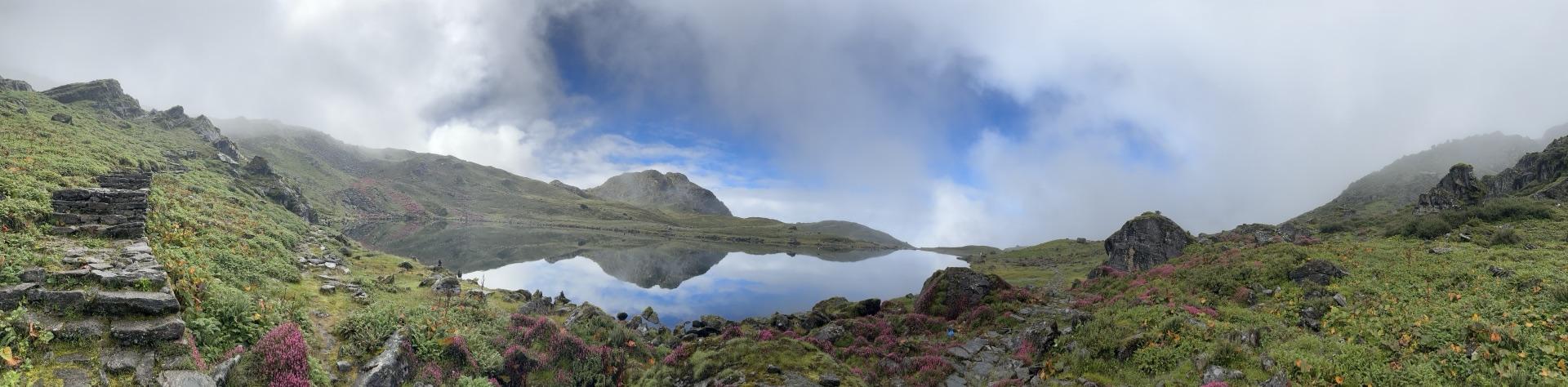
We ran up the low ridge above the shore and took the group photos, everyone squinting and grinning like we'd won something. Then we mostly stood around, turning in slow circles, trying to look at everything at once.
Forty minutes. That's roughly what the camera roll says we got. By half past eight the cloud walked back in and put it all away, lake by lake, and by nine we stood in the same whiteout as the night before — grinning now, because we knew what was inside it.
Afterwards we lay flat on our backs in the meadow grass, hands behind our heads, near yaks that paid us no attention at all. I remember thinking I should be thinking something profound. What I actually thought was: I could eat three plates of dal bhat right now. Later, I did.
As it happened
05:47 the basin, theoretically
06:06 the temple; pilgrims already in place, tarp up
07:23 the sun attempts, fails
07:30 the dip. THE DIP.
07:51 blue sky, unannounced
08:14 the big lake turns into a mirror
08:22 group photo — all four, all teeth
08:30 the cloud files a counterclaim
09:15 whiteout again; nobody minds
Day 03
Down the stairs, led by the stomach
Panch PokhariNasim PatiTuppi Danda
Down is a different sport played with the same equipment. The lungs relax and the knees start filing complaints. We gave the weather until midday to open again — it declined — then took the staircase in reverse, recrossed the bridge in the late afternoon, and came out on a ridge standing clear above a valley full of cloud. Yesterday's white, now below our feet. We stopped for a while just to be above it, arms out.
The smell from that kitchen ended the plan in about four seconds.
The plan said continue down to Chhimti and sleep low. Then we reached Tuppi Danda at dinner time, and the smell from that kitchen ended the plan in about four seconds. Nobody argued the case; packs just started coming off. Same table as two nights before, same dal bhat, same sukuti, same steel cups — better this time, because now we'd earned it twice.
As it happened
08:48 flat in the grass; the grass won
08:54 sat with the yaks; they allowed it
12:08 turned for home
16:48 recrossed the bridge
17:41 on top of the weather, arms out
19:00 Tuppi Danda — the rematch
Day 04
Against the current, all the way home
Tuppi DandaChhimtiMelamchiBhaktapur
The last morning, the village was floating: cloud filled the entire valley below, and the blue roofs sat on top of it in the sun. We took ridiculous photos in ponchos at the waterfall below the village. A small boy watched our breakfast with great seriousness and offered no comment. And as we walked down toward the bikes, the Janai Purnima traffic was coming up — families, old men, kids in sandals, moving light and fast, headed for the water we'd had nearly to ourselves. Every few minutes, another namaste. It felt like leaving a concert just as the crowd was arriving, knowing we'd heard the soundcheck alone.
We did nothing to deserve it, except show up, freeze, and wait.
The mud detour was still there. We rode it better the second time — worse ground, better technique — and then the long road home: down the Indrawati past the flood scars, through Melamchi, over the Sanga hill beneath the same enormous Shiva, who had not moved. Bhaktapur took us back with the last of the light — ears ringing, boots heavier by a kilo of dried mud each, smelling of rain, engine, and four days of the same clothes.
The photos from the trip say what photos say: lakes, fog, stairs, four guys grinning. But what actually comes back — mostly at night, when rain gets loud on the roof — is the smaller stuff. Steel cups refilled without anyone asking. Drums carrying through wet forest. The particular silence of four people too tired to talk, still walking. And forty minutes of sun on still water that we did nothing to deserve, except show up, freeze, and wait.
If you ever find yourself on a bike some August morning — rain in the forecast, a bag roped to the rack — I know exactly where I'd tell you to point it.
As it happened
06:55 cascade, poncho, photoshoot
07:50 breakfast, with an audience
10:05 dal bhat — one for the road
12:08 rice terraces, one quiet observer
13:54 the mud again — better technique this time
16:41 tea stop; bikes loaded for the last leg
~19:00 Bhaktapur, by dark
The ledger
days4
friends4 — all still on speaking terms
motorbikes3, all returned upright
distance, all modes~200 km ridden, ~40 km walked
landslide crossed on foot1 — the pillion, by group decision
dal bhat plateslost count; double digits
vertical meters of staircase~1,800
goats blocking the stairs1 — it stayed; we went around
icy dips1 — no words, in any language
steel cup refillsuncounted, never requested
lakes, painted5 — available all day
lakes, real5 — for about forty minutes
regrets0